
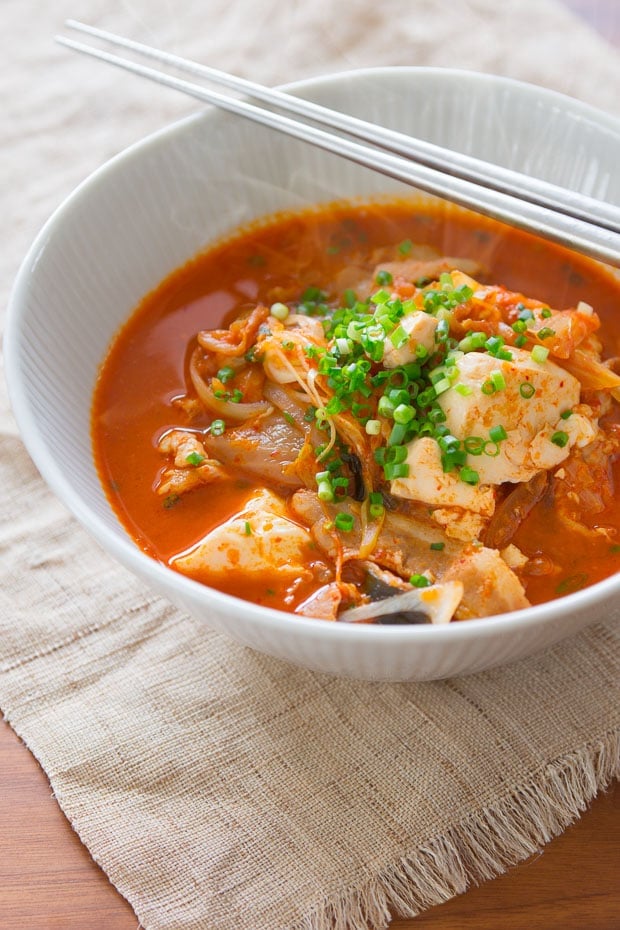
It's been seven years since I started this blog, and nearly five since I posted my Kimchi Jjigae (김치찌개). If I kept track of such things, I've probably cooked this dish more times than any other. It's not just about using leftovers, or having a good taste to effort ratio, this stew delivers the perfect amalgamation of umami, heat and substance which both literally and figuratively warm the soul.
When I'm not developing recipes for work, I tend to wing it in the kitchen, which is why my favorite dishes evolve over time. I've made a number of refinements to the recipe since I posted it, which is why I've decided to share an update with you. Below is the original post along with my revised recipe:
Given my recent sojourn in Korea I thought it only appropriate to do a post I've been meaning to do for a very long time: Kimchi Jjigae. Depending on who you ask, you may see it transliterated as Kimchi Chigae, Kimchi Soup or Kimchi Stew, but it all refers to the same bubbling, red hot cauldron of soul satisfying soup made with kimchi, pork and tofu.
I wasn't able to find a ton of information on its origins, but it's not a stretch to imagine this dish was conceived back in humbler times as a way to use old over-fermented kimchi along with a few scarce scraps of meat. When paired with a bowl of hot rice, it will jump start your internal furnace and chase away even the most frigid of winter chills.
Like its German cousin sauerkraut, the various strains of Lactobacillus in kimchi convert the sugars in the cabbage into acids over time. At some point, most people find that kimchi gets too tart, making it unpleasant to eat straight out of the jar, but this is the perfect time to turn it into Kimchi Jjigae. The tartness mellows out as it stews with the pork belly and it helps to balance the rich fat from the belly.
For those that have never had it before, Kimchi Jjigae may look like it packs a face-melting punch, but it's not nearly as spicy as it looks. Unlike some Latin American chili peppers, Korean chilies are less potent, contributing sweetness in addition to heat. Of course if you like things scorching hot like me, you can crank the volume by adding more gochugaru.

While every household has their own secrets for making their kimchi jjigae, here are mine:
- Marinate the meat - It may seem silly to marinate something that's going to be cooking in a liquid but the marinade caramelizes as you fry the meat, which gives the soup more depth.
- Use the kimchi juice - This is the red liquid that is released from the cabbage as it's being pickled. Every package will have some at the bottom and you can squeeze the kimchi with your hands to get more. This stew is even better with homemade kimchi, and I have a fairly easy recipe for Small Batch Kimchi that demystifies the process.
- Add a bit of doengjang - Doengjang is a fermented soybean paste similar to miso that packs a wallop of umami and adds a wonderfully earthy taste to the jjigae.
- Add butter at the end - This may sound really odd, but it thickens the soup and gives it a wonderful richness without being greasy. The key is to add it just before serving so it emulsifies in the soup (if you add it too early the milk solids and fat will separate and make the soup oily)
More Korean Classics
Recipe
Kimchi Jjigae
Ingredients
- 150 grams skinless pork belly (sliced thinly)
- 15 grams garlic (3 large cloves, grated)
- 7 grams fresh ginger (grated)
- 1 tablespoon gukganjang (Korean soup soy sauce)
- 1 tablespoon Soju
- 110 grams onion (½ small sliced thin)
- 200 grams kimchi (~1 cup tightly packed)
- ½ cup kimchi juice (squeezed from kimchi)
- 1 ½ cups water
- 2 teaspoons gochujang (Korean chili paste)
- 2 teaspoons doenjang (Korean bean paste)
- 2 tablespoons gochugaru (Korean chili flakes to taste)
- 225 grams soft tofu (cut into large cubes)
- 2 scallions (thinly sliced)
- 1 tablespoon cultured unsalted butter
Instructions
- Marinate the 150 grams skinless pork belly with the 15 grams garlic, 7 grams fresh ginger, 1 tablespoon gukganjang and s1 tablespoon Soju while you prepare the other ingredients.

- Heat a heavy bottomed pot until hot and then add the pork belly. Allow some of the fat to render out of the pork belly, then add the 110 grams onion and 200 grams kimchi. Sauté until the mixture is very fragrant.
- Add the ½ cup kimchi juice, 1 ½ cups water, 2 teaspoons gochujang, and 2 teaspoons doenjang, stirring everything together to combine.
- Bring to a boil and taste for spiciness, adjust with 2 tablespoons gochugaru to increase the heat to where you want it.
- Add the 225 grams soft tofu, turn down the heat to a simmer and let it cook for 15-20 minutes, or until the pork and kimchi are tender.
- When you're ready to serve the kimchi jjigae, add the 2 scallions and 1 tablespoon cultured unsalted butter and give it a quick stir to incorporate. Put a trivet on the table and serve it straight out of the pot along with a bowl of rice.


Nutrition Facts
Recipes in your inbox
I'll send you recipes and ideas to get you excited about cooking.



auntysam says
Is this the same recipe from about 5 years ago? The ingredients sort of look the same except for the soju. I noticed there are a few adjustments to the ingredients and directions, but for the most part, it's the same. If this is, it's delicious!
Marc Matsumoto says
Thanks1 Auntysam! I did update this recipe slightly in 2014 from an earlier version. The changes were improvements I'd made to the recipe over the years. It has not changed since then and is still how I make this dish today.
Cinzia says
I can't count how many times I made this soup with this recipe: it's always so tasty and better than most of the restaurants I tried it at! Thanks Marc for sharing 🙂
Marc Matsumoto says
Hi Cinzia, I'm so glad to hear you've been enjoying this! Thanks for dropping by to let me know. This is one of my personal favorites! Hope you had a good weekend!
Sam says
Been making your Kimchee Jigae for many years, it’s one of our favorite soups, especially during our Ohio winters. In a pinch I have used meaty bacon instead of pork belly🤫and it still turned out great. Thanks for your detailed recipe.
Marc Matsumoto says
Hi Sam, I'm glad to hear you've been enjoying this! Thanks for stopping by let me know. I've seen Korean friends making this with SPAM so I think bacon is allowed😉
Marc Matsumoto says
Hi Debra, I'm so glad to hear you enjoyed this! Yes, this is great when really spicy, but everyone has a different heat tolerance so I'm glad to hear you were able to adjust to your liking.
debra verdadero says
Made it lastnite and was awesome, I added more hot chilie sauce I like it hot/spicey ?
taylor savusa says
Finally made it and love it
Marc Matsumoto says
Hi Omer, wow that is high praise, thanks for sharing!
Omer M-Jung says
My husband said it was *almost* as good as his grandmother's- now that is high praise!
Debra says
Made it several times already added more chilli flakes
Nia says
I'm eating this as I write. Superb recipe! Doenjang definitely made a world of difference too
Rita Chen says
WOW
Jeff Howe says
This sounds delicious - going to make this tonight.
Garry Perkins says
I also put doenjiang in my Kimchi chigae, but I often rotate meats to what I have lying around. I have used a box of chicken stock when I had no meat (okay), Canadian bacon (awesome), and ground pork (okay). Although I would say that I also like to add more onion (a whole one vs your half), and I add one or two small finely chopped shallots. I add these to almost everything and it always works. Furthermore, if you can get your hands on fancy mushrooms (morels, chanterelles), they are awesome in this (or anything else). I will also do oyster mushrooms or shiitake caps if I have them on hand, and I always do. But if you are the type to hunt for morels in the local forest preserve, this is a great place to throw a few in.
Julie Clarkson says
Thanks for the recipe! I made it last night and it really reminded us of the kimchi jjigae that we ate on our trip to Korea - spicy and satisfying. I'll definitely make it again 🙂
fastu says
Wonderful recipe and pork belly is probably the only protein that I haven't tried in
Kimchi Jjigae. This was the first adult food that I tried as a toddler and I still drool every single time I even see a picture of it...............(sigh) :)))
Marc Matsumoto says
Hi Emma, if you don't like things spicy then this dish is probably not for you. While the spiciness will depend on the amount of chili pepper you add as well as the spiciness of your kimchi it's obviously going to be a little spicy due to the nature of the soup.
Emma says
Just wondering if this dish is spicy and if so what i can do to make it less spicy, i cant really handle things that are too hot/spicy but ive always wanted to try this
Jon says
Fantastic recipe, I used wild boar meat instead of pork belly and it gives the stew a much more meaty, earthy taste. It needed to cook for about 45 mins to get really tender. I had to cut some corners with the bean paste and used a miso-based broth as replacement but it was great anyway. My last batch of kimchi was also insanely hot so I did not add any gochujang and just a little chili flakes, the heat was plenty enough anyway. Mouth on fire!
Marc Matsumoto says
I woolncathairs, as long as the pork isn't too seasoned, it should work, but it may make your pork kind of dry.
woolncathairs says
Could I use slow-cooked BBQ pork in this dish? I do it myself and it melts in your mouth.
Marc Matsumoto says
Hi Faye, did you use pork belly? If so, the stiffness was probably a result of not cooking it long enough. Meat with a lot of fat and connective tissue like pork belly need time for the connective tissues to breakdown, otherwise they will be tough. Cutting it thicker will make it take longer, which is why I recommend slicing it thinly.
Faye says
Hi! Thank you for sharing your recipe I just tried it and it was amazing ^^ I used thicker slices of pork which ended up being quite stiff and hard though. I was wondering if anyone has any tips on how to get them to stay tender? Will simply slicing them thinner help or have I just overcooked them?
Marc Matsumoto says
Hi Linda, I don't believe there is a such thing as a terrible cook. I'm glad to hear this dish worked out for you:-)
Linda T says
Disclaimer: I am a terrible cook... but this recipe was amazing. My dish turned out delicious. Maybe I am not a terrible cook after all. =) I can't wait to try your other recipes! Thank you Thank you!
Carmy Wong says
I made this for the first time using chicken instead (not a pork belly person myself) just recently and it tasted really good. My husband who is most of the time a vegetarian also liked it.
Chef Frank says
I would like permission to re-post this to my Facebook groups and pages.
Chef Frank Helisek
Micki says
OK, I need more experience making kimchi. I liked this recipe a lot, but added a little paprika to make it redder. I suspect it didn't change the taste a whole lot. My kimchi was mostly green And since my kimchi was too salty (I'll get better at making that), the stew came out a little too salty. I threw in a potato (that's supposed to help, and maybe did a little). I fished out the potato and ate it separately with a little sesame oil and soy sauce. It was fabulous. I will definitely make this again. But I really don't think 25 minutes is long enough to cook it. I had a cup after half an hour, and the next cup (an hour later) was definitely better.
Jannie says
I cook Korean a lot.....Learned this from Korean friends...LOVE THIS FOOD!
Marc Matsumoto says
Hi Catherine, thanks so much for taking the time to write a comment. I’m so glad to hear you enjoyed it:-) —
Sent from Mailbox
Catherine Loa says
This is a great recipe! I had not idea what to make for dinner and stumbled upon your lovely page. I spent some time wandering in a Korean market during my lunch break looking for gochujang and doengjang which were thankfully very easy to find. I doubled the recipe and made a good sized pot. Instructions and recipe were easy to follow and the result were fabulous! Yummy in my tummy. My father was a bit skeptical at first since I am relatively new to the kitchen and the cooking responsibility having been thrust upon me... I am always searching for quick dinners. The Family LOVED it. Easy+quick+tasty. =) Thank you for making my life easier today.
KB says
I just made this tonight and it was very delicious! Tasted like a restaurant quality dish, I was very pleased. My family enjoyed this, too. I ended up subbing sake for the soju and red miso for the doejgqjang because I forgot to buy these ingredients. Still came out very good, next time I will try it without subs. Thanks for a great recipe and easy instructions 🙂
Olivia says
Dear Marc, I just tried to cook your recipe... and it's super delicious, My husband loved it, and he just finished a very large bowl of kimchi chigae haha thank youuuu 🙂
hotsumi says
Marc, Thank you for reply and what you said is a great idea..
Marc Matsumoto says
Hi hotsumi, if you have a smartphone, just do a google images search ( images.google.com) for the ingredients you want to see the next time you're at the store. If you don't just do a google images search on your computer and then print out photos to bring with you next time. I live in Japan, so it's not going to be very helpful for you to see photos of the brands I'm using.
hotsumi says
Marc I'm clueless on korean spices or container what it looks like, same thing pretty much Chinese recipes, where I live is country side compare to where you live, can you post some pictures, I go to Ktown in Los Angeles a lot, I was lost ended up just buying Kim chee to take home..
Angela says
I am Korean and I think this recipe is great! Some notes I made for myself were to reduce the amount of kimchi juice if using old kimchi (very fermented, very sour kimchi), and adjust the amount of doenjang depending on the variety used (e.g. use less if using strongly flavored doenjang such as the kind my mother gives me 🙂 ). Also country ribs are a great substitute for pork belly, and easily found in U.S. supermarkets.