

What is Nokedli?
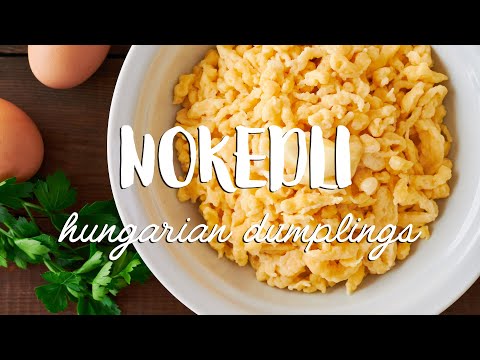
Hungarian Nokedli (sometimes called Galuska) are small Central European dumplings that are closely related to German spätzle. These miniature dumplings come together from simple ingredients, and are basically a free-form egg noodle. That's probably how American-style Paprika Chicken came to be served with egg noodles.
Because they're formed and dropped into a pot to cook simultaneously, they take on random shapes with nooks and crannies that make them perfect for holding onto sauces. This one step process also speeds things up, allowing you to make this homemade Hungarian Nokedli recipe from scratch in about the time it takes to boil a pack of store-bought pasta. And I've included instructions for how to make nokedli without a nokedli maker.
Jump to:
The Dough
Nokedli are made from a loose dough prepared with flour and eggs. Because these aren't rolled out and cut like pasta, the dough is very wet, coming in somewhere between waffle batter and bread dough in consistency.
While it's not traditional, I like adding a bit of sour cream to my Hungarian dumpling recipe for two reasons. The first is that the dairy adds a nice buttery flavor to the dumplings. The second reason is that the fat in the sour cream helps prevent the formation of gluten, making these soft and pillowy rather than tough and chewy.
Because eggs tend to vary in size, and sour cream varies in viscosity, you may or may not need to add some milk or water to adjust the texture of the dough. How loose you want to make the mixture depends mostly on how you plan to shape your Hungarian Nokedli. If you're going to use a knife or a spoon to cut pieces of dough off into the boiling water, you'll want to make it a little firmer, and if you're going to extrude it through holes, you'll want to make the dough a bit looser.
If you have the time, I recommend letting the dough rest for about 30 minutes. This allows the gluten in the flour to relax a bit, which not only makes it easier to work with; you'll end up with a more delicate dumpling.
How to Shape Nokedli
There are a bunch of different methods for shaping Hungarian Nokedli, and you can even do it without any special tools. Here are a few of my preferred methods:

Board & Knife
The traditional method is to put the dough on a wet wooden board and then use the back of a knife, or spoon, to cut small dumplings into a pot of boiling water. I usually use the back of a large spatula for this as the dough won't stick to it as much as it will stick to a piece of wood. The great thing about this method is that you don't need any special tools to make it. The dumplings tend to be a bit larger than with other methods, but you do have some control over how big they are. If you end up going with this method, I recommend making the dough a little firmer than you would for using the extrusion methods listed below. Check out the video below to see this technique in action.
Cheese Grater
This is my favorite method for making Nokedli and can be done using anything with medium-sized holes spaced far enough apart, such as the back of a cheese grater or a perforated spoon. The idea is that you load your chosen implement up with a small amount of dough, and then use a silicone spatula to press the dough through the holes. It's easier to see this in action than to explain it, so check out the video below to see how it's done. It does take a little elbow grease, but there's something super satisfying about watching the little dumplings emerge from the holes.
Potato Ricer
A potato ricer is like a giant garlic press, and it allows you to fill the hopper with dough, and then squeeze out the Nokedli. This is probably the fastest method of making these dumplings, but you need a ricer with interchangeable discs. You want to use a disk with relatively large holes that are spaced further apart. If you use one with small holes spaced too close together, the extruded dough will stick back together again before it hits the water.
Nokedli (Spätzle) Maker - There are dedicated tools for shaping Nokedli. They work fine and quickly produce consistent results, but unless you're planning on making these a lot (or have an infinite amount of storage space in your kitchen), I usually recommend against buying such specialty tools. If you follow my instructions on how to make nokedli without one, you'll have perfect nokedli without going to the expense or cluttering up your storage space.
Cooking Nokedli
There's not much to cooking the dough; however you want to be sure to work in small batches, as overcooking the Nokedli will make them mushy. Using a large pot of water will help maintain temperature consistency. Once they float, give them an additional thirty seconds to ensure they're cooked through, and transfer them to a bowl with a lid to keep them warm while you make the rest.

What to Serve with Nokedli
Nokedli are traditionally served as a side dish in Hungary, and Chicken Paprikash without Nokedli would be like Wile E. Coyote without the Road Runner. I also like to serve these with Goulash, and they're perfect for adding a bit of substance to lighter soups. The craggy pitted surface of each dumping holds onto sauces like a champ, which also makes them a great homemade pasta that works with everything from Bolognese to Carbonara.
My guess is that you won't have any leftovers, but if you do end up making too much, Hungarian Nokedli are fantastic pan-fried with a little melted butter or olive oil until the surface just starts to brown. These would make a great accompaniment to my Cabbage and Chicken Stew.
📖 Recipe

Equipment


Units
Ingredients
- 140 grams bread flour (about 1 cup)
- ¼ teaspoon salt
- 2 large eggs
- 2 tablespoons sour cream (or yogurt)
- 2 tablespoons milk (you may need more or less)
- cultured unsalted butter (for serving)
Instructions
- Whisk the 140 grams bread flour and ¼ teaspoon salt together in a bowl.

- Add the 2 large eggs and 2 tablespoons sour cream and stir the mixture to combine.
- Stir in 1 of the 2 tablespoons milk at a time until your dough is soft, but not runny. If you are using the board and knife method, the dough should be a little firmer. If you are pressing the dough through holes, it should be loose enough to squeeze through the holes with a spatula, but not so loose that it drips through them on their own.
- When you're ready to make the Nokedli, bring a large pot of salted water to a boil.
- Use one of the methods in the headnotes to form your dumplings and drop them into the boiling water. Do this in relatively small batches, or you will end up with some dumplings that are overcooked. When you're done adding the dumplings, give them about 30 seconds after they float to the surface to ensure they are cooked.
- Use a slotted spoon to transfer them to a bowl as they cook, and cover the bowl to keep them warm. Serve the Nokedli tossed with cultured unsalted butter or a little olive oil to keep them from sticking together.


Peter Shortall says
I've made this recipe twice and it came out really well both times, I had it with chicken paprikash and mushroom paprikash. Many thanks!
Marc Matsumoto says
You're welcome Peter! Glad to hear you've been enjoying this!
Lynda says
hello can these nokedli be frozen before using in a dish? need to make a bunch for a chicken pakrikash will they hold up in freezer? Thanks for the instructions and recipe.
Marc Matsumoto says
Hi Lynda, good question and to be totally honest I've never tried it so I'm not 100% sure. That being said I think it should work, the key will be to drain them very well (excess water will make them bloat) and to apply a liberal amount of olive oil or duck/chicken fat to them so they don't stick together. I don't recommend using butter if you plan on freezing them as butter is about 17% water.
Fenevad says
I freeze these all the time. I usually make about twice what I need because the incremental effort of doubling the recipe is nothing compared to making them at all. They freeze extremely well and heat up with no trouble at all.
Richard Ford says
Well, for some reason I've been missing international food (can't think why!) and my last trip to Budapest was on my mind, so Chicken Paprikash and Nokedli was tonight's menu. What a hit. I used a cheese grater as my Nokedli shaper and it worked just fine creating that Nokedli shape that is part of their charm. Definitely a keeper - the returns WAY exceed the time and effort you need to put in - this recipe is QUICK. Thanks Marc!
Marc Matsumoto says
Glad to hear you enjoyed it Richard! Thanks for taking the time to let me know. I know what you mean about craving international food. This was the first time in my life I wasn't on a plane to a different country for a whole year. Hopefully things get back to normal soon!
Lori says
Made them and super easy and delicious. I used regular flour as didn’t not have any bread flour in the house
Marc Matsumoto says
Hi Lori, I'm glad to hear you enjoyed these! Using bread flour gives them a slightly firmer texture, but all purpose flour will work fine.
Madahen says
Made these and they were easy and delicious, thank you so much
Marc Matsumoto says
Happy to hear you enjoyed them!
Carole Rohrbacher says
Can these be frozen ?
Marc Matsumoto says
Hi Carole, I haven't tried it, but I think they may end up hard when you heat them.
Char says
I freeze it all the time, and it does freeze well. Put it in a large zip lock bag and lay flat in your freeze. Add some butter to the noodles before you freeze and then put in a pot of boiling water just to heat it up.
Rebecca Zynda says
I'd love to see some older figurines.