
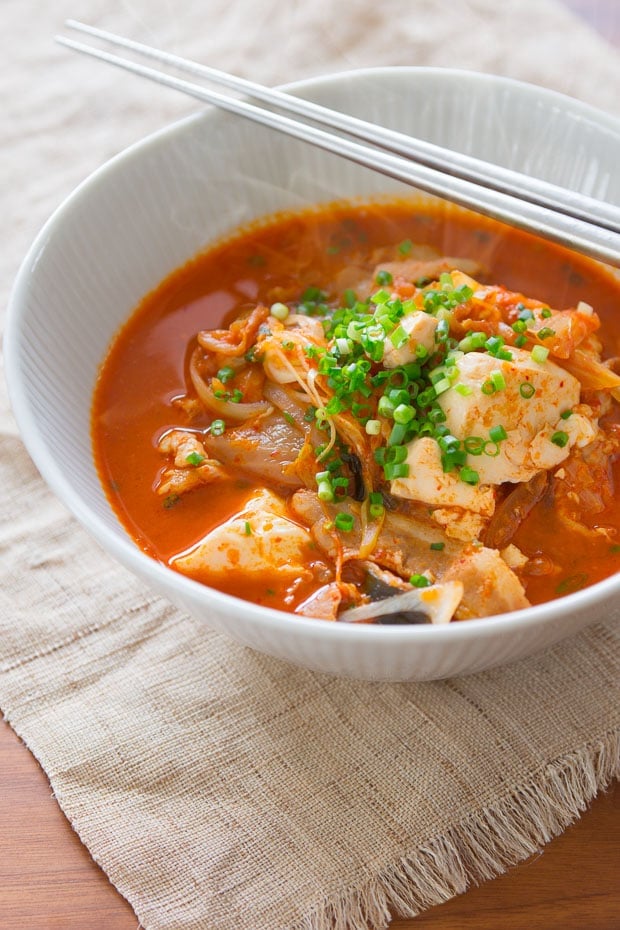
It's been seven years since I started this blog, and nearly five since I posted my Kimchi Jjigae (김치찌개). If I kept track of such things, I've probably cooked this dish more times than any other. It's not just about using leftovers, or having a good taste to effort ratio, this stew delivers the perfect amalgamation of umami, heat and substance which both literally and figuratively warm the soul.
When I'm not developing recipes for work, I tend to wing it in the kitchen, which is why my favorite dishes evolve over time. I've made a number of refinements to the recipe since I posted it, which is why I've decided to share an update with you. Below is the original post along with my revised recipe:
Given my recent sojourn in Korea I thought it only appropriate to do a post I've been meaning to do for a very long time: Kimchi Jjigae. Depending on who you ask, you may see it transliterated as Kimchi Chigae, Kimchi Soup or Kimchi Stew, but it all refers to the same bubbling, red hot cauldron of soul satisfying soup made with kimchi, pork and tofu.
I wasn't able to find a ton of information on its origins, but it's not a stretch to imagine this dish was conceived back in humbler times as a way to use old over-fermented kimchi along with a few scarce scraps of meat. When paired with a bowl of hot rice, it will jump start your internal furnace and chase away even the most frigid of winter chills.
Like its German cousin sauerkraut, the various strains of Lactobacillus in kimchi convert the sugars in the cabbage into acids over time. At some point, most people find that kimchi gets too tart, making it unpleasant to eat straight out of the jar, but this is the perfect time to turn it into Kimchi Jjigae. The tartness mellows out as it stews with the pork belly and it helps to balance the rich fat from the belly.
For those that have never had it before, Kimchi Jjigae may look like it packs a face-melting punch, but it's not nearly as spicy as it looks. Unlike some Latin American chili peppers, Korean chilies are less potent, contributing sweetness in addition to heat. Of course if you like things scorching hot like me, you can crank the volume by adding more gochugaru.

While every household has their own secrets for making their kimchi jjigae, here are mine:
- Marinate the meat - It may seem silly to marinate something that's going to be cooking in a liquid but the marinade caramelizes as you fry the meat, which gives the soup more depth.
- Use the kimchi juice - This is the red liquid that is released from the cabbage as it's being pickled. Every package will have some at the bottom and you can squeeze the kimchi with your hands to get more. This stew is even better with homemade kimchi, and I have a fairly easy recipe for Small Batch Kimchi that demystifies the process.
- Add a bit of doengjang - Doengjang is a fermented soybean paste similar to miso that packs a wallop of umami and adds a wonderfully earthy taste to the jjigae.
- Add butter at the end - This may sound really odd, but it thickens the soup and gives it a wonderful richness without being greasy. The key is to add it just before serving so it emulsifies in the soup (if you add it too early the milk solids and fat will separate and make the soup oily)
More Korean Classics
📖 Recipe


Units
Ingredients
Marinate
- 150 grams skinless pork belly (sliced thinly)
- 15 grams garlic (3 large cloves, grated)
- 7 grams fresh ginger (grated)
- 1 tablespoon gukganjang (Korean soup soy sauce)
- 1 tablespoon Soju
Stir Fry
- 110 grams onion (½ small sliced thin)
- 200 grams kimchi (~1 cup tightly packed)
Soup
- ½ cup kimchi juice (squeezed from kimchi)
- 1 ½ cups water
- 2 teaspoons gochujang (Korean chili paste)
- 2 teaspoons doenjang (Korean bean paste)
- 2 tablespoons gochugaru (Korean chili flakes to taste)
- 225 grams soft tofu (cut into large cubes)
Finish
- 2 scallions (thinly sliced)
- 1 tablespoon cultured unsalted butter
Instructions
- Marinate the 150 grams skinless pork belly with the 15 grams garlic, 7 grams fresh ginger, 1 tablespoon gukganjang and s1 tablespoon Soju while you prepare the other ingredients.

- Heat a heavy bottomed pot until hot and then add the pork belly. Allow some of the fat to render out of the pork belly, then add the 110 grams onion and 200 grams kimchi. Sauté until the mixture is very fragrant.
- Add the ½ cup kimchi juice, 1 ½ cups water, 2 teaspoons gochujang, and 2 teaspoons doenjang, stirring everything together to combine.
- Bring to a boil and taste for spiciness, adjust with 2 tablespoons gochugaru to increase the heat to where you want it.
- Add the 225 grams soft tofu, turn down the heat to a simmer and let it cook for 15-20 minutes, or until the pork and kimchi are tender.
- When you're ready to serve the kimchi jjigae, add the 2 scallions and 1 tablespoon cultured unsalted butter and give it a quick stir to incorporate. Put a trivet on the table and serve it straight out of the pot along with a bowl of rice.


James hawkins says
fifty years ago I worked with the ROK army north of the Imjin river. I was in the ground surveilance platoon of a US army unit but attached to the ROK unit. During my TDY I was served a soup made with kimchee, pork ,tangjang, goachajan, and potatoes. It was delicious. I have served in Korea ten years since then but have never found that taste in any other soup. Prehaps it was the company of my fellow soldiers that made it taste so good.
Maryjane0307 says
I like to use a leaner pork and i also add bean sprouts. delicious!
Robertcarr says
cow's belly or honeycomb tripe
Tdmcz28 says
Yum yum...making mine right now....
Yeni Kim says
맛있겠다 ~ 주세요
Yooniecorn says
I wan't some now. so hungry.... -___-
Lina Kim ♥ says
aah this is my favorite jigae! I'm eating it right now ^^
Marc Matsumoto says
The stews at BCD are a different dish called Sundubu Jjigae, but you can certainly add seafood to this if you want. Just put it in at the very end so it doesn't overcook.
Marshall Rogers-Martínez says
At BCD tofu houses they serve this with shrimp or clams or other meat/seafood in it. Does anyone know how to incorporate those things? Can you just add it in anytime? Do you drop the protein stuff in after it's been cooking for a while and then take off the heat sort of like how you add the raw beef at the end of making Pho?
Thomas Abraham says
Thank you for posting this recipe! I have a much simpler version, but this is so much better. I must try your "butter tip" next time!
Taylor says
I'm vegan and I make this all the time without the pork and it is delicious. I just use some sesame oil or any veg oil to saute the onion in. I usually add extra tofu too.
Marc Matsumoto says
The taste would be different, but you could substitute beef .
Marissa says
That sounds delicious. But, due to my religion, I cannot eat pork. Is there anything that can replace the pork belly, to make it taste as good as the real kimchi jigae?
koala70 says
I am a Korean and have cooked this dish countless times, but add butter? I can't wait to try!
Will let you know how it turn out and what family and friends say 🙂
karas says
I don't think this is very authentic. Sounds nothing like what my mommy makes.
Cryochic says
Had a lot of kimchi so my husband said to try making this soup. I tweeked it just a bit substituting what I had on hand...ie Sambal for the chili paste, etc. I also used some leftover pork roast since I had made more than needed the night before. Added bell pepper, zucchini and mushrooms also, since we love veggies.
My husband said that it was some of the best soup he's ever had and he ate 4 huge bowls with rice.
Now, that's a compliment!!!! Thank you so much for this fabulous recipe. Now I know what to do with all of that kimchi in my frig !!!
gettingaheadache says
Please change the typeface to something readable. Gill Sans Ultra Condensed was not meant to be a text faces.
alice says
this was a wonderfully delicious soup. i made my own kimchi using the kitchen wench's recipe and it was just great for this dish. including miso and butter was brilliant and not something i would have thought of on my own. kunjip was my favorite korean place when i lived in new york but now i'm in portland and it's much harder to find tasty korean food. thanks for the recipe!
Glen says
Just made this for my kimchi-wary family. They were pleasantly surprised and actually enjoyed it! I think I actually liked it better than the kimchi jjigae I had in Seoul.
SJP says
Loved the recipe! The green onion and butter at the end really makes a massive difference...
I made several changes since my neighborhood whole foods isn't necessarily 'asian friendly'... For folks who can't get the gochujang and gochugaru, I used black bean paste and finely chopped habanero chillies (i used 2 but use caution, those things are HOT). Also, I used bacon instead of pork belly, which makes the soup a little oily, but doesn't seem to spoil the taste too much... Also, i added mushrooms coz i had some lying around...
Aubrey says
i've made kimchi chigae before but your version of it... mmm, yummy! i like how i can taste the butter at the end, it actually made it creamy. =)
Lydia says
oh! my boyfriend kept saying his mom puts dwenjang in Kimchi Jjigae ~, but it didn't sound right in my head either, so I thought of miso, I didn't know other people were doing it, too.
Marc Matsumoto says
It should feed 3 comfortably or 4 if you're serving it with other things.
Abc says
Cheers, gonna surprise the Korean wife when she gets home from work tomight
louise says
I'm making this right now and it smells SOOO good! Om Nom Nom.
Julia says
Just made this for lunch. It was delicious. I didn't add butter or miso but it tastes great as it is. It was easy to make.
Cfruga says
Had some left over taejigogi and used it instead of the pork belly. This recipe worked really well!
Clifford says
I use this recipe all the time... my wife and friends love it... i use pieces of spare pork ribs w/ out bone to get more flavor... I get comments that mine are better than most ajumas!
Jeanny says
This is such a lovely, oddly gourmet version of kimchi jjigae!
I have to say, kimchi jjigae is one dish that tastes awesome with Spam. Koreans love Spam.
Krystle says
I am asian and quarter karian and i love kemchi jagae
sabeena ibrahim says
Awesome, thanks for the reply! (:
Marc Matsumoto says
You could use chicken or beef, but it would change the taste. If you'regoing to use chicken I'd suggest thigh meat, as breast meat will get driedout. As for the dengjang it's not a traditional addition but I like thenutty body it adds to the soup.
sabeena ibrahim says
I don't eat pork, can I use chicken as a substitute instead? Which part would you recommend? It will be my first time making, so I've been doing a lot of research on it. I've noticed that this is the first recipe which I've come across using dwenjang. Is it necessary, or does it help enhance the flavour like mirin?
Marc Matsumoto says
A lot of big chain grocery stores (Safeway, Albertsons, Railey's,WholeFoods, Trader Joes, etc) sell it in the same section as tofu in areaswhere there's even a small asian population. If not, try checking an asiangrocery store.
Asiangurlo95 says
do u know where they sell pickled cabbage/kimchi in the U.S.?
Marc Matsumoto says
Nope, not necessary, but it will effect the flavor if you leave it out.
Carolyn says
Is it necessary to put cooking wine??
Marc Matsumoto says
Traditionally it's cooked and served in a small earthenware pot to keep ithot, but you could use any pot to cook it in. Keep in mind that thick potshelp distribute heat evenly, so ideally it would be something with a thickbottom.
Anonymous says
Is it essential for the recipe to be cooked in a small laquered cast iron pot, or is it alright to use any pot?
preppygal says
shocking results yet amazing! i *SARANG* it! ^-^;;
yulee says
"Add miso. I know, this is technically a Japanese ingredient" Actually miso is a traditional Korean ingredient. It's just called by a different name - dwenjang
Kimchi king says
Butter in a kimchi gigae? Noooooo!!
M Good says
You are a genius! I think this recipe is better than any version I've had at Korean restaurants. The dengjang (miso-like paste) was a critical addition, and I chose to use 2x the amount of pork belly to make the dish a little richer. Really loved this one!
Marc Matsumoto says
That should work just as well:-)
Elle says
I couldn't get pork belly here either, unless I wanted to buy a 12lb slab. My butcher suggested boneless pork spareribs, and he sliced them thin for me!
Amy (Minimally Invasive) says
Oh boy, I've been craving this like crazy for the past few weeks, but haven't gotten around to ordering it. Now I won't have to! Just a quick trip to the store for some kimchi and I'm all set. Thanks for the recipe!
Su says
Thank you for this delicious recipe.
I've never made this before, and tried it today, as a way to finish up some kimchi. It was happily slurped up and heartily enjoyed on a cold, gloomy January day. I thought the additions of miso and butter resulted in a very balanced, flavorful broth. It was sour, sweet, spicy, salty and oh so good!
khowser says
Made this! It's a really mellow, rich flavor. I didn't de-fat the pork belly, so at the end, I couldn't imagine adding even more richness to the dish. It was good as is.
I served it to my mom, but she's old school Korean, and said it didn't really taste like kimchi jigae (too sweet, not bracing enough, didn't like the "adulterating" miso and onions--god forbid I tell her this had *soy sauce* in it). Exactly! Hers is like, the epitome of kimchi jigae and if I wanted that, I'd have some of hers! But I did make my own version with her homemade kimchi--the best.
Marc Matsumoto says
Well, the best kimchi is home-made, but the kind that comes in the white foil bags is not bad. It's imported from Korea and there's a photo of kimchi on the front. You can get it at H-Mart on the north side of 32nd st.', '0
Marc Matsumoto says
Well, the best kimchi is home-made, but the kind that comes in the white foil bags is not bad. It's imported from Korea and there's a photo of kimchi on the front. You can get it at H-Mart on the north side of 32nd st.