
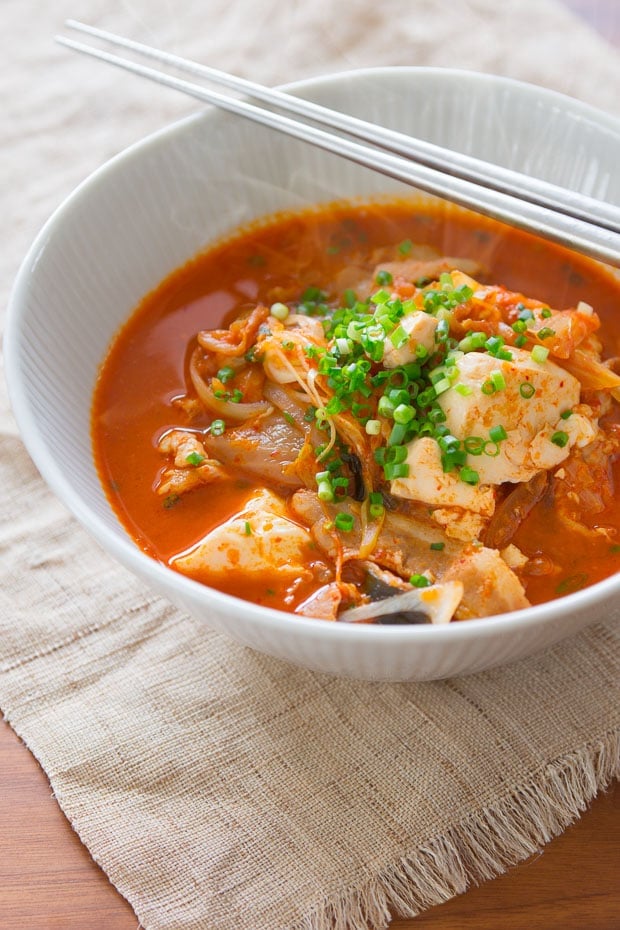
It's been seven years since I started this blog, and nearly five since I posted my Kimchi Jjigae (김치찌개). If I kept track of such things, I've probably cooked this dish more times than any other. It's not just about using leftovers, or having a good taste to effort ratio, this stew delivers the perfect amalgamation of umami, heat and substance which both literally and figuratively warm the soul.
When I'm not developing recipes for work, I tend to wing it in the kitchen, which is why my favorite dishes evolve over time. I've made a number of refinements to the recipe since I posted it, which is why I've decided to share an update with you. Below is the original post along with my revised recipe:
Given my recent sojourn in Korea I thought it only appropriate to do a post I've been meaning to do for a very long time: Kimchi Jjigae. Depending on who you ask, you may see it transliterated as Kimchi Chigae, Kimchi Soup or Kimchi Stew, but it all refers to the same bubbling, red hot cauldron of soul satisfying soup made with kimchi, pork and tofu.
I wasn't able to find a ton of information on its origins, but it's not a stretch to imagine this dish was conceived back in humbler times as a way to use old over-fermented kimchi along with a few scarce scraps of meat. When paired with a bowl of hot rice, it will jump start your internal furnace and chase away even the most frigid of winter chills.
Like its German cousin sauerkraut, the various strains of Lactobacillus in kimchi convert the sugars in the cabbage into acids over time. At some point, most people find that kimchi gets too tart, making it unpleasant to eat straight out of the jar, but this is the perfect time to turn it into Kimchi Jjigae. The tartness mellows out as it stews with the pork belly and it helps to balance the rich fat from the belly.
For those that have never had it before, Kimchi Jjigae may look like it packs a face-melting punch, but it's not nearly as spicy as it looks. Unlike some Latin American chili peppers, Korean chilies are less potent, contributing sweetness in addition to heat. Of course if you like things scorching hot like me, you can crank the volume by adding more gochugaru.

While every household has their own secrets for making their kimchi jjigae, here are mine:
- Marinate the meat - It may seem silly to marinate something that's going to be cooking in a liquid but the marinade caramelizes as you fry the meat, which gives the soup more depth.
- Use the kimchi juice - This is the red liquid that is released from the cabbage as it's being pickled. Every package will have some at the bottom and you can squeeze the kimchi with your hands to get more. This stew is even better with homemade kimchi, and I have a fairly easy recipe for Small Batch Kimchi that demystifies the process.
- Add a bit of doengjang - Doengjang is a fermented soybean paste similar to miso that packs a wallop of umami and adds a wonderfully earthy taste to the jjigae.
- Add butter at the end - This may sound really odd, but it thickens the soup and gives it a wonderful richness without being greasy. The key is to add it just before serving so it emulsifies in the soup (if you add it too early the milk solids and fat will separate and make the soup oily)
More Korean Classics
📖 Recipe


Units
Ingredients
Marinate
- 150 grams skinless pork belly (sliced thinly)
- 15 grams garlic (3 large cloves, grated)
- 7 grams fresh ginger (grated)
- 1 tablespoon gukganjang (Korean soup soy sauce)
- 1 tablespoon Soju
Stir Fry
- 110 grams onion (½ small sliced thin)
- 200 grams kimchi (~1 cup tightly packed)
Soup
- ½ cup kimchi juice (squeezed from kimchi)
- 1 ½ cups water
- 2 teaspoons gochujang (Korean chili paste)
- 2 teaspoons doenjang (Korean bean paste)
- 2 tablespoons gochugaru (Korean chili flakes to taste)
- 225 grams soft tofu (cut into large cubes)
Finish
- 2 scallions (thinly sliced)
- 1 tablespoon cultured unsalted butter
Instructions
- Marinate the 150 grams skinless pork belly with the 15 grams garlic, 7 grams fresh ginger, 1 tablespoon gukganjang and s1 tablespoon Soju while you prepare the other ingredients.

- Heat a heavy bottomed pot until hot and then add the pork belly. Allow some of the fat to render out of the pork belly, then add the 110 grams onion and 200 grams kimchi. Sauté until the mixture is very fragrant.
- Add the ½ cup kimchi juice, 1 ½ cups water, 2 teaspoons gochujang, and 2 teaspoons doenjang, stirring everything together to combine.
- Bring to a boil and taste for spiciness, adjust with 2 tablespoons gochugaru to increase the heat to where you want it.
- Add the 225 grams soft tofu, turn down the heat to a simmer and let it cook for 15-20 minutes, or until the pork and kimchi are tender.
- When you're ready to serve the kimchi jjigae, add the 2 scallions and 1 tablespoon cultured unsalted butter and give it a quick stir to incorporate. Put a trivet on the table and serve it straight out of the pot along with a bowl of rice.


Evelyn says
Tried your recipe today and its absolutely delicious! :)))
Andrew says
Just wanted to say thanks for the recipe. I've used it for years now, with some variation. My secret is that I use beef stock instead of water, gives the stew some extra depth (but I might recommend reducing the doengjang in this instance). Also instead of butter I whip an egg (or 2, depending on the pot size) into the mix to thicken it up. If you ever try those variations, let me know what you think!
Joanne says
I've cooked your recipe about 4 times now and everyone i cook it for ABSOLUTELY LOVES IT!
Marc Matsumoto says
I actually used to use miso as well, but I decided I like the bolder flavor of doengjang with this. But if you add too much, it ends up overpowering the kimchi, which is why I only use a bit. It adds a subtle fermented nuttiness and lots of umami, but there isn't enough of it to be immediately recognizable.
Vijay - Editor @ NoshOn.It says
Love the idea of adding doengjang. I often add miso to my kimchi jigae to give the broth more body!
kathleenditommaso says
I think it's the fermentation. I haven't (sinful I know), made my own kimchi. Given that unfermented might help to sway him: game on! Many thanks for the suggestion. He also doesn't like garlic. And he's Italian/German to boot. I could roll in garlic, onions & kimchi all day long like a kid at a water slide park!
Marc Matsumoto says
Oops, typo!
sarah says
Oh man, I just made this last night with your old recipe! Didn't have any gochujang so replaced it with tobanjan, it still turned out tasty. I can imagine this new one is much tastier, so I'll be sure to try it next time. One thing though, the Korean chili flakes you mentioned in the recipe, do you mean gochugaru instead of gochujang?
Marc Matsumoto says
There's not much you can do aside from getting him to eat it:-) On that front, what about the kimchi does he find offensive? Is it the spice? Garlic? Or the fermented taste? If it's the garlic or spice you could make your own kimchi and cut back on either ingredient. If it's the latter, kimchi is actually great unfermented as well, which makes it taste more like a spicy garlicky salad. Here's my recipe for making kimchi https://norecipes.com/recipe/kimchi/
kathleenditommaso says
Lovely, but I prepare & eat this alone as hubby has yet to understand the need to eat kimchi. That being said, how does one displace the odor? I only ask because of the groaning I hear after cooking w/it. While I'm 1 to dab a bit behind my ear 'cause I love it so.... I wonder for those not so inclined, is there a method of clearing the air for their benefit? Ya ought to hear the whimpering when I'm simply caramelizing onions &/or garlic....
encee says
I noticed my local Vietnamese supermarket here in London was selling kimchi. I had not even heard of it until recently (it's strangely become fashionable over here all of a sudden) - if you've not had it before, this is a really good introduction. I would possibly use just a little belly pork next time and substitute beef or chicken for the main part. All that fat from the belly does give it a delicious rich, deep flavour but it is a bit much as you finish the bowl. A definite keeper.
Alice says
This is the tastiest kimchee jjigae I've ever tasted! I made it for hubby and he was amazed! (I'm not good at cooking, so I'm grateful that u posted this! Thank you so much! I'm looking forward to trying out your other recipes. Please make youtube videos of your recipes!!!! : )
ehmh says
What a great recipe! I can't believe how easy but ultra-super-tasty it was! I've been craving good Korean food since I returned from Australia, and since local Korean restaurants are just awful- I am sooooo thankful to you for this recipe! Cheers!
Marc Matsumoto says
I'll add it to the list:-)
Thomas Abraham says
sounds good thanks!! Oh also is it possible to request recipes? Have you ever made Kalbi jim ( beef short ribs braised stew)---If you have would you mind sharing it??
Marc Matsumoto says
I've seen people put canned tuna into kimchi jjigae in Korea, but the soup base usually still has pork in it. You could substitute chicken or beef, or if you wanted to make it entirely seafood, you could take a stock from dried anchovies (myeolchi) first.
Thomas Abraham says
Can this altered so that another meat is used instead of pork? I heard about using tuna in some kimchi jigae recipes..have you ever tried that?
ιиfιиιту says
Oh, nice.
brian lee says
this page is so cool
Marc Matsumoto says
If I make the kimchi I let it ferment for about 3 weeks in the fridge. If it's store bought you have to taste it to figure it out as you don't know when it was made. When it's ready the stem part of the cabbage will go from off white to yellowish and the kimchi will be very tart. You can speed the process up by leaving it out at room temperature (will only take a couple of days)
Marc Matsumoto says
If I make the kimchi I let it ferment for about 3 weeks in the fridge. If it's store bought you have to taste it to figure it out as you don't know when it was made. When it's ready the stem part of the cabbage will go from off white to yellowish and the kimchi will be very tart.
Guest says
How long did you ferment your kimchi for stews?
Jiajia says
How long did you ferment your kimchi? Is it refrigerated or not ? Thanks
misskit103 says
and oh minus miso - that will fight against the rich broth from the kimchi.
misskit103 says
butter? that sounds disgusting. this is one of the most authentic korean dishes - no butter is necessary or required
Rio says
I did the same
Rio says
Thank for the recipe I wanted to aleast make kimchi jigae once since the first time i try it the soup turn out great except i used chicken instead of pork because i'm watching my weight.
Thomas Abraham says
i like kimchi, gusto wong matutong mg luto ng kimchi soup
H Lena says
I tried this out and its awesome! Used sukiyaki pork (they are super thin and convenient for this recipe) and though I did not add butter, its still better than the normal kimchi soup I get from some restaurants in SG. My mother and sisters are impressed, and I am satisfied. Thanks for the awesome recipe 😀
(the miso replacement is great cos I personally do not fancy korean style bean paste!)
Thomas Abraham says
I know this is going to sound like sacrilege to some, but my mom always used beef. Granted we grew up fairly poor, so she just used whatever kind of meat we had around (typically cheaper cuts of beef for things like pot roast). She would just cut a small handful off of what she had. If you do use beef, you want to cook it completely through before adding any liquid so it doesn't make the gross fat foam that happens when you boil raw meat.
Cindy says
My Korean mother is known as the best kimchi maker in our town and I always make this soup with her kimchi after it starts to turn sour in about 3 weeks. She uses pork neck bones which are flavorful and very cheap. I also use dark meat chicken.
KD Smith says
The pork is definitely a distinctive flavor that is difficult to substitute. That said, there would be little harm in experimenting. I would suggest a first try with one-third lamb shank and two-thirds turkey or chicken thighs (skinless but not boneless (for the additional flavor)). Venison would also be an interesting substitute.
Helen says
oh, i also add some fermented bean paste (the chinese kind).
Helen says
i make a version of this with vegetables and no meat and it tastes great. saute onions and garlic, then add kimchi and saute. then add veg stock or water. to that, add vegetables of your choice.. i like it with enoki mushrooms and zucchini, but you can use other veg from your fridge. mushrooms are always great to add depth. let boil till vegetables are as cooked as you like them. then add soft tofu for about a minute. turn off heat and miso at the end (i mix miso with some of the soup stock to dissolve before adding to the pot). i taste and add more miso as needed. enjoy!
hector says
Only one place in my county serves this and it is watery, bland, and less spicy than a cucumber. Thank you for this fantastic recipe!
kim Min Ki says
do we have to add the pork can i use beef instead
pick says
i've made this about 3-4 times now, and it's always yummy! sometimes i throw in half water half chicken stock for a bit more flavor. as long as you follow most of the basic ingredients in this recipe, you can mix it up a dozen different ways and it tastes great each time. fun recipe! 🙂
M Radecki says
Fantastic!!!
Bhei_cuteangel says
I love your recipes! ...... so very delicious
Woxihuan82 says
I like tart kimchi's taste, so I won't put miso. Thank you for your recipe.
Marc Matsumoto says
It depends on how hungry you are, but it should feed around 4 people.
Bobguy111 says
How many servings does this make?
Marc Matsumoto says
It adds richness and body to the soup.
Gyoolnara says
I don't understand why you put butter in the soup.
Marc Matsumoto says
Yep just grate it and add about a teaspoon.
Yze29 says
if i dont have dried ginger , can i use fresh instead?
Marc Matsumoto says
It's not going to taste the same, but you can certainly try it and see if it works for you.
eun mi says
what if you you don't want to use garlic cloves can you us garlic powder?!
Stephanie from NY says
Great recipe. I'm not sure if anyone mentioned this but I added a tsp of sesame oil at the end, along with a little butter. Turned out tasting as good as mom's!
Ghenry232 says
I was interested in trying to find an answer to this question (although I am not dietarily restricted from consuming pig, although they can be very intelligent creatures...) and found a few things I thought I'd share.
Many suggest replacing Pork fat with unsalted butter, which is interesting in the context of this recipe calling for exactly that as a just-in-time modification at service time.
Others suggested replacing with vegetable oil; I found an article talking about a modification process someone's developed to make non-pig oil that is very similar in all characteristics (other than actually being pig) to pig fat:
https://www.foodnavigator.com/Science-Nutrition/Vegetable-oil-mix-may-substitute-for-pork-fat-in-meats
There's also the consideration that you could TRY and substitute some other animal fat, although there is no direct substitute for pig flavor-wise. Lamb? Goat? Game meat? The issue there is that those are in descending order of fat content, and lamb has a strong characteristic flavor. I'm sure it'd be NICE with this soup, but slightly different. Maybe find a butcher who occasionally has more exotic meats that are higher-fat than most (buffalo perhaps?) and see whether you can get some belly cuts from that sliced up on the mandolin? For what it's worth, I have lamb broth that I'm thinking of making this soup with so maybe I'll post again afterwards to let you know how it turned out in terms of flavor compatibility.