

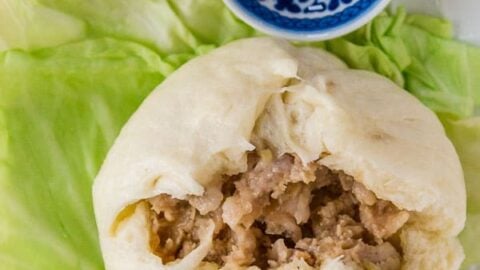
Nikuman (肉まん), also known as Bāozi in China and Pork Buns in the West, are the Asian equivalent to sandwiches. With a savory meat and vegetable filling wrapped in dough and steamed, these Japanese pork buns make a complete meal that can be eaten on the go without utensils.
While convenient, I've always been a little wary of the mystery-meat filled steamed Japanese pork buns you can buy at the store. They taste good, but the bleached white dough is often too sweet, the skimpy filling a little prepubescent, and the unidentifiable meat inexplicably pink.
On a recent trip to Kyoto, I made the mistake of boarding a noon train without buying lunch. By the time the bullet train reached Kyoto station I was ready to start gnawing on the seat in front of me. It didn't help that the guy sitting next to me had brought on a bento box and a tallboy of beer.
As I entered the station from the platform, the sweet smell of pork perfumed the air. Led by my nose like a bloodhound, I soon found myself standing in front of a stall called Horai 551, in line with a bunch of other hungry travelers.
I don't know if it was my hunger or Horai 551's recipe, but it was one of the best Japanese pork buns I'd ever had. With a relatively thin bun and incredibly soft and juicy filling redolent of onions, I ended up back in line for a second Nikuman.

I've been trying to recreate Horai 551's Nikuman since that trip, getting closer with each batch. Today's batch not only met my expectations, I dare say these steamed Japanese pork buns are better than Horai's. The filling is moist and tender with loads of umami flavor coming from the meat, mushrooms and onions. The fluffy, mildy sweet bun is a wonderful contrast to the dense texture of the savory filling.
The trick is to use a mixture of ground pork and sliced pork belly; the extra fat ensures that your filling is juicy. The trouble is, too much juice, and your bun gets soggy. That's where the cornstarch and egg white comes in. They not only act as a tenderizer, they also help bind the juices to the meat so they don't absorb into the bun, creating that perfect contrast in textures which makes Japanese pork buns so pleasurable to eat.

This recipe makes 8 large meal-sized buns, but you can just divide everything into 16 segments to make appetizer sized Japanese pork buns that are perfect for bringing to potlucks.
They're best straight out of the steamer, but they do take a bit of time to make, so I like to make a large batch and freeze them. Nikuman keeps for about a month in the freezer. To bring them back to life, just wrap them in a damp paper towel and microwave for a few minutes for nearly instant gratification.
Other Japanese-Chinese Favorites
- Shumai
- Harumaki (Japanese Spring Rolls)
- Japanese Sweet and Sour Chicken
- Best Japanese Gyoza
- Chili Shrimp (Ebi Chili)
- Yakimeshi (Japanese Fried Rice)
Recipe
Best Nikuman (Japanese Pork Buns)
Equipment
Ingredients
- 500 grams all-purpose flour
- 100 grams granulated sugar
- 2 teaspoons instant dry yeast
- 1 ½ teaspoons baking powder
- ½ teaspoon salt
- 2 tablespoons vegetable oil
- 1 cup warm water ~ 120° F or 48°C
- 1 medium onion (finely diced)
- 5 scallions or green onions (white part only, minced)
- 1 tablespoon toasted sesame oil
- 300 grams pork belly (thinly sliced, then roughly chopped)
- 100 grams ground pork
- 3 dried shiitake mushrooms (rehydrated, then chopped)
- 2.5 centimeters fresh ginger (grated, about 1 tablespoon)
- 2 tablespoons oyster sauce
- 1 tablespoon soy sauce
- 1 tablespoon sake
- 2 teaspoons granulated sugar
- ½ teaspoon ground black pepper
- 2 tablespoons potato starch (halve is using cornstarch)
- 1 egg white
Instructions
- Mix the 500 grams all-purpose flour, 100 grams granulated sugar, 2 teaspoons instant dry yeast, ½ teaspoon salt, and 1 ½ teaspoons baking powder together in the mixing bowl of a stand mixer, then pour in the 1 cup warm water and 2 tablespoons vegetable oil and combine. When the ingredients are combined, affix the bowl to a mixer fitted with a dough hook and knead until the dough is elastic and shiny. You can also knead the dough by hand if you don't have a mixer.

- Form the dough into a ball and put it in a bowl and cover with plastic wrap. Place the bowl in a warm place and let the dough rise until its doubled in size (about 1 hour). Cut 8 squares of parchment paper to place the buns on for steaming.
- While you're waiting for the dough to rise, make the filling. Sauté the 1 medium onion and 5 scallions or green onions with the 1 tablespoon toasted sesame oil in a pan over medium heat until translucent, but not browned. Set them aside to cool.
- In a bowl, combine the 300 grams pork belly, 100 grams ground pork, 3 dried shiitake mushrooms, 2.5 centimeters fresh ginger, 2 tablespoons oyster sauce, 1 tablespoon soy sauce, 1 tablespoon sake, 2 teaspoons granulated sugar, ½ teaspoon ground black pepper, 2 tablespoons potato starch and 1 egg white and knead well with your hands (gloves are advisable), add the cooled onions and continue kneading until the meat is shiny and well combined.
- Punch down the dough and roll it into a log. Cut the log into 8 even pieces and form each piece into a ball. Space the balls apart on a baking sheet and cover with a damp towel to keep them from drying out. Let the dough rest for 10 minutes.
- Use a sharp knife to divide the meat filling into 8 pieces. With your hands or a rolling pin, flatten a piece of dough on a piece of parchment paper until it's about the size of the piece of paper, and then scoop ⅛th of the meat filling onto the middle of the dough.
- Pinch one edge of the dough with your right hand and twist it up towards the center of the bun. Use your left hand to hold the flap in place. Repeat about 10 times, always bringing the flap up to your left hand and pinching together with the past flaps. Place each finished bun on a square of parchment paper.
- Cover the finished buns with a damp towel to keep them from drying out. Fill a steamer with water and boil the water. Place a few buns into a bamboo steamer, being careful not to overcrowd it as the buns will expand.
- Place the bamboo steamer over the pot of boiling water.
- Steam the buns for 15 minutes. Depending on your steamer setup it may take a little more time, so split one open at 15 minutes to make sure it's cooked through, or test filling with an instant read thermometer. It should read 165 degrees Fahrenheit, or 74 degrees Celsius. Serve the nikuman with spicy mustard, hot sauce, or vinegar.


Nutrition Facts
Recipes in your inbox
I'll send you recipes and ideas to get you excited about cooking.



Dr. O says
I’ve tried several recipes for nikuman (bao or siopao) over the years, your recipe for the dough is the best. (I did my own chicken filling). I’ve made your recipe twice. Your recipe is fool proof. The first time I added a bit of water. The second time, I did not have to adjust the water. I used bao flour the second time. I added 1/4 teaspoon of titanium oxide to make it whiter the second time. I don’t think it made the dough significantly whiter. I omitted the salt. Thank you for sharing your recipes!
Marc Matsumoto says
You're welcome! I'm happy to hear you've been enjoying this. Also, thanks for sharing your experiments. I make this with all-purpose flour because I like the chewier texture, but bleached cake flour will get you a lighter color bun with a texture that's more cakey and less chewy.
Jason says
Really delicious nikuman recipe, haven't really tried any other recipes yet as I keep coming back to this one.
Marc Matsumoto says
Hi Jason, I'm happy to hear you've been enjoying this! Thanks for letting me know!
Magdalena says
Hi, i like the filling. It is very tasty. The dough is much to sweet for me. I would give 1/2 sugar less then now, or maybe even a little more. The amount of the dough is also too much for me, I think it would be ok for a 10-12 buns filling? But definitely I will make it again!
Marc says
Thanks Magdalena, food in Japan tends to be pretty sweet and I know it's not to everyone's taste. If its any consolation, I do try and reduce the amount of sugar used in my versions of these dishes relative to what you would typically find here. I'm glad you were able to find ways to adjust the recipe to suit your preferences.
Magdalena says
I was in Japan a few years ago but I couldn’t try everything, so now I make by my own those delicious food that I wasn’t able to taste there 😉 for example, tuna-mayo onigiri is my favorite to-go sandwich by now 🤤 I will try to make those nikuman my second favorite.
Kathy Stroup says
My daughter has asked for these 3 days in a row! She calls them, "Meat Flowers", because I cut them into 6 wedges to make them easier for her to eat. The bread unfolds like a flower! It really moves me how much she loves your recipes. I am so grateful to have your influence in our lives.
Marc Matsumoto says
Thanks for sharing, this put a smile on my face!
Michi says
Hi there Marc,
I made these a very long time ago and my son happened to ask for them last week. For the life of me can't remember if it is the Japanese ウスター sauce the recipe calls for.
Marc Matsumoto says
Hi Michi, this recipe does not call for Worcestershire sauce. It's seasoned with oyster sauce and soy sauce.
Kathy says
I can't believe how long it took me to try this -all the wasted years! The dough was perfection. I did sub out 100g of AP flour with pastry flour, lowering the gluten and imparting that perfect, pillowy texture. And I added some salted cabbage and carrot to the filling to lighten it a bit. I really loved the textures! I only wish there was a video so that I could watch how you pleat the tops. I did okay, but when I watch you, I always improve.
Marc Matsumoto says
Hi Kathy, better late than never😉 I'm glad to hear you enjoyed this, and thanks for the reminder about this, now I'm craving these. Great idea using pastry flour for the dough and adding some veggies. This one would be a 2-day shoot (+3 day editing) which makes it a little challenging to fit into my weekly schedule, but I'll see if I can squeeze a video for it in somewhere.
Kathy says
I understand that you're busy, and I get by with my "technique". Glad to return the favor of giving you cravings! Your site is literally overwhelming with all of the incredible recipes! I have to keep a napkin close by when I read through it to sop up all the drool.🤤 So many things I want to try. Even if I don't get to cooking everything here, I am so grateful for the tips and techniques I am picking up. What a fantastic achievement and a great record of your development as a cook, teacher, and writer.👏🤩💖
Marc Matsumoto says
Thanks Kathy 😊
Kathy says
Making Nikuman Buns for Day 6 of my Marc Matsumoto Marathon! Any celebration of your wondrous achievements would be incomplete without these! This one is committed to memory, as well as a recipe card in my kitchen. I've lost count of the number of times I have made these!
Marc Matsumoto says
Hahaha, that means you've probabably made these more than me. It's been years since I've made them 😅
Amanda Sun says
Hi Marc, can one make this vegetarian?
Marc Matsumoto says
Hi Paloma, yes ideally this is eaten hot. Though it's fine at room temperature as well. It will not taste very good refrigerated though.
Paloma Araya says
do you have to eat it hot?
Taylor Jones says
Thank you for sharing this recipe, I made it as a first time making pork buns at home and omg this recipe is so yummy! I can't wait to make them again!
Taylor Jones says
Hi there
Marc Matsumoto says
Hi Mallory, it will effect both, but this should still taste good without them.
Mallory Holden says
Would it affect the flavor/texture of the filling if the mushrooms were omitted? These look and sound amazing, but there are mushroom allergies in my family and I really don't want to risk it.
Luminariel says
Thank you for posting and sharing this recipe. I'm hoping to make these for mmy boyfriend for his birthday this month. He lived in Japan when he was younger, he was a military kid. I hope this brings back memories of his favorite places from that time. Thank you so much!
Akota says
Too much sugar. Makes the dough taste like bread from Chinese stores.
I found the steamed dough to be too sweet compared to European standards...
kindly grammar nazi says
Were you really weary (tired) of the store-bought nikumans, or were you WARY of them (feeling or showing caution)?
Marc Matsumoto says
Yep it's sticky and makes for quite a workout if you don't have an electric mixer, but fully developing the gluten should not only improve the texture of the bun, it will also make it a lot easier to work with when you stuff it (i.e you shouldn't need to use flour).
Otokage says
Oh, the problem must be there then. I did it with my hands for 5 minutes but I gave up since it started annoying me :p Thnx for the tip.
Marc Matsumoto says
The dough should have a firmness more like sandwich bread than french bread (i.e. softer). It's very light and airy due to the double leavening (yeast and baking powder). Hope that helps.
Vivian Diggs says
Thank you for replying so promptly. I will try to experiment. Should the dough be like a bread type of dough? Knowing this will help me a lot.
Marc Matsumoto says
Based on your description I think the most likely culprit is that the dough wasn't kneaded for long enough. You really need to develop the gluten in the dough to get it elastic and smooth so it does not stick so much. It probably takes about 5-7 minutes in a stand mixer but much longer if you're doing it by hand.
Otokage says
Way more messy as it was impossible to make a ball with it. Although after waiting for the 1h, I could handle it just fine by filling my hands with flour before touching it to make the log. I noticed though that it grew a lot after being cooked. It was intented for 4 buns, but next time I will use it to make five so they are a little smaller. The texture was great though 🙂 although both the meat and the dough were pretty tasteless due to the lack of salt. I will add some salt next time and post here how it worked out.
Thanks for the recipe!
Marc Matsumoto says
This is a relatively soft dough so it's not the easiest to work with, but it should not be that sticky. Did your dough look like the photo in step 1 after kneading and the photo in step 2 after rising?
Otokage says
is it normal for the dough to be sticky as hell? I haven't cooked it yet, but as sticky as it is, it seems it will be impossible to handle it in order to make the buns...
Marc Matsumoto says
Hi Vivian, while it's probably possible, it's definitely not as simple as swapping out the AP flour for a GF alternative. Since this dough is double leavened (with yeast and baking powder) it should be a little easier than some breads, it's probably going to take some experimenting to get right. My gut says some mixture of glutinous rice flour, regular rice flour, tapioca starch, and HPMC should get you there, but you'll have to experiment on the proportions to get a dough that rises properly.
Vivian Diggs says
Is there a way to make a gluten free dough?
Marc Matsumoto says
Hi Cyrus, the best way to do this is to freeze the curry in a large ice cube tray and then wrap the frozen curry. Hope that helps.
Cyrus Rustom says
Thought so. Trying to do a curry version with a Japanese curry sauce but not working due to curry being to wet. Would using gelatine to set curry then wrapping it work...dough doesn't seem to like wrapping wetter fillings. Cheers for quick response
Marc Matsumoto says
Hi Cyrus, you should definitely steam them before freezing. I would not recommend freezing the uncooked dough as it will likely make a mess and not rise when you go to cook it.
Cyrus Rustom says
Do these need to be steamed before freezing? Could you cook filling stuff uncooked dough then freeze?
Lo Fan says
I baked these. Turned out better than the steamed variety which I find too stodgy