

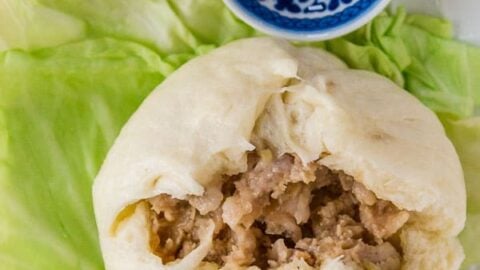
Nikuman (肉まん), also known as Bāozi in China and Pork Buns in the West, are the Asian equivalent to sandwiches. With a savory meat and vegetable filling wrapped in dough and steamed, these Japanese pork buns make a complete meal that can be eaten on the go without utensils.
While convenient, I've always been a little wary of the mystery-meat filled steamed Japanese pork buns you can buy at the store. They taste good, but the bleached white dough is often too sweet, the skimpy filling a little prepubescent, and the unidentifiable meat inexplicably pink.
On a recent trip to Kyoto, I made the mistake of boarding a noon train without buying lunch. By the time the bullet train reached Kyoto station I was ready to start gnawing on the seat in front of me. It didn't help that the guy sitting next to me had brought on a bento box and a tallboy of beer.
As I entered the station from the platform, the sweet smell of pork perfumed the air. Led by my nose like a bloodhound, I soon found myself standing in front of a stall called Horai 551, in line with a bunch of other hungry travelers.
I don't know if it was my hunger or Horai 551's recipe, but it was one of the best Japanese pork buns I'd ever had. With a relatively thin bun and incredibly soft and juicy filling redolent of onions, I ended up back in line for a second Nikuman.

I've been trying to recreate Horai 551's Nikuman since that trip, getting closer with each batch. Today's batch not only met my expectations, I dare say these steamed Japanese pork buns are better than Horai's. The filling is moist and tender with loads of umami flavor coming from the meat, mushrooms and onions. The fluffy, mildy sweet bun is a wonderful contrast to the dense texture of the savory filling.
The trick is to use a mixture of ground pork and sliced pork belly; the extra fat ensures that your filling is juicy. The trouble is, too much juice, and your bun gets soggy. That's where the cornstarch and egg white comes in. They not only act as a tenderizer, they also help bind the juices to the meat so they don't absorb into the bun, creating that perfect contrast in textures which makes Japanese pork buns so pleasurable to eat.

This recipe makes 8 large meal-sized buns, but you can just divide everything into 16 segments to make appetizer sized Japanese pork buns that are perfect for bringing to potlucks.
They're best straight out of the steamer, but they do take a bit of time to make, so I like to make a large batch and freeze them. Nikuman keeps for about a month in the freezer. To bring them back to life, just wrap them in a damp paper towel and microwave for a few minutes for nearly instant gratification.
Other Japanese-Chinese Favorites
- Shumai
- Harumaki (Japanese Spring Rolls)
- Japanese Sweet and Sour Chicken
- Best Japanese Gyoza
- Chili Shrimp (Ebi Chili)
- Yakimeshi (Japanese Fried Rice)
Recipe
Best Nikuman (Japanese Pork Buns)
Equipment
Ingredients
- 500 grams all-purpose flour
- 100 grams granulated sugar
- 2 teaspoons instant dry yeast
- 1 ½ teaspoons baking powder
- ½ teaspoon salt
- 2 tablespoons vegetable oil
- 1 cup warm water ~ 120° F or 48°C
- 1 medium onion (finely diced)
- 5 scallions or green onions (white part only, minced)
- 1 tablespoon toasted sesame oil
- 300 grams pork belly (thinly sliced, then roughly chopped)
- 100 grams ground pork
- 3 dried shiitake mushrooms (rehydrated, then chopped)
- 2.5 centimeters fresh ginger (grated, about 1 tablespoon)
- 2 tablespoons oyster sauce
- 1 tablespoon soy sauce
- 1 tablespoon sake
- 2 teaspoons granulated sugar
- ½ teaspoon ground black pepper
- 2 tablespoons potato starch (halve is using cornstarch)
- 1 egg white
Instructions
- Mix the 500 grams all-purpose flour, 100 grams granulated sugar, 2 teaspoons instant dry yeast, ½ teaspoon salt, and 1 ½ teaspoons baking powder together in the mixing bowl of a stand mixer, then pour in the 1 cup warm water and 2 tablespoons vegetable oil and combine. When the ingredients are combined, affix the bowl to a mixer fitted with a dough hook and knead until the dough is elastic and shiny. You can also knead the dough by hand if you don't have a mixer.

- Form the dough into a ball and put it in a bowl and cover with plastic wrap. Place the bowl in a warm place and let the dough rise until its doubled in size (about 1 hour). Cut 8 squares of parchment paper to place the buns on for steaming.
- While you're waiting for the dough to rise, make the filling. Sauté the 1 medium onion and 5 scallions or green onions with the 1 tablespoon toasted sesame oil in a pan over medium heat until translucent, but not browned. Set them aside to cool.
- In a bowl, combine the 300 grams pork belly, 100 grams ground pork, 3 dried shiitake mushrooms, 2.5 centimeters fresh ginger, 2 tablespoons oyster sauce, 1 tablespoon soy sauce, 1 tablespoon sake, 2 teaspoons granulated sugar, ½ teaspoon ground black pepper, 2 tablespoons potato starch and 1 egg white and knead well with your hands (gloves are advisable), add the cooled onions and continue kneading until the meat is shiny and well combined.
- Punch down the dough and roll it into a log. Cut the log into 8 even pieces and form each piece into a ball. Space the balls apart on a baking sheet and cover with a damp towel to keep them from drying out. Let the dough rest for 10 minutes.
- Use a sharp knife to divide the meat filling into 8 pieces. With your hands or a rolling pin, flatten a piece of dough on a piece of parchment paper until it's about the size of the piece of paper, and then scoop ⅛th of the meat filling onto the middle of the dough.
- Pinch one edge of the dough with your right hand and twist it up towards the center of the bun. Use your left hand to hold the flap in place. Repeat about 10 times, always bringing the flap up to your left hand and pinching together with the past flaps. Place each finished bun on a square of parchment paper.
- Cover the finished buns with a damp towel to keep them from drying out. Fill a steamer with water and boil the water. Place a few buns into a bamboo steamer, being careful not to overcrowd it as the buns will expand.
- Place the bamboo steamer over the pot of boiling water.
- Steam the buns for 15 minutes. Depending on your steamer setup it may take a little more time, so split one open at 15 minutes to make sure it's cooked through, or test filling with an instant read thermometer. It should read 165 degrees Fahrenheit, or 74 degrees Celsius. Serve the nikuman with spicy mustard, hot sauce, or vinegar.


Nutrition Facts
Recipes in your inbox
I'll send you recipes and ideas to get you excited about cooking.



Glenn Baux says
I was excited for the recipe. Since I usually modify recipes I added my sour dough starter and salt to the recipe dough. It turned out (dough) very acidic and alcoholic after tones. I was sad. The filling was great. The dough, probably would have been better to not add my twist. I use the same starter for french bread and it tasted fantastic. In your recipe it was way out of range for taste. Have you ever added a starter to your bun dough process?
Danil Luzin says
Amazing recipe! Dough is absolute gold! Tried making vegetable version (due to wanting to make those, and not wanting to go and shop for the meat) and turned out perfectly! Just as i remember them back in China )) For sure going to experiment with filling more! Thanks man!)
Marc Matsumoto says
Hi Busle Busle, glad to hear you enjoyed them. I took a look at your buns, but they look great. You may just need to stretch the pleats a bit more the next time.
Jane says
Apparently, being a jerk online is a sign of manliness now.
Marc Matsumoto says
Trim the skin off along with any excessive fat, you want about a 50:50 mix of meat and fat.
—
Sent from Mailbox
Thuy says
Do you have to cut the rind off the pork belly or do you leave it on?
Marc Matsumoto says
HI Skyroll, sorry to hear you didn't enjoy it. It is definitely very meaty ("nikuman" literally means "meat bun") so if you're looking for a lighter one, this isn't it. As for the dough, the baking powder is there to give the dough extra lift (to make the bun part lighter and fluffier), and is a fairly typical addition to Chinese buns. Did you take photos of the buns by any chance? Did they look like the photos above?
Skyroll says
Thanks for the recipe. I made these today, and it was pretty BAD, the dough turned out yellow / brownish and was terribly flat plus the filling was far too meaty to my family's liking. We love the chinese and korean version with cabbage or other vegetables.
The flavour of the sake, ginger and shitake mushrooms which I normally love, were here, overwhelming. I tried a different recipe today as well, which doesn't use baking powder and it yelded far better results... sorry I really didn't enjoy your recipe in the end and don't know what went wrong. Was it really the baking powder? most recipes call for it, I don't understand T_T
Bradley Campbell says
I just made these today and they turned out amazingly! I didn't have a steam basket so I used a plate on top on a ramekin in a big pot and they still turned out great. The flavor combination is so moist and delicious, thanks for sharing an excellent recipe
arfi says
Will do that. Thanks, Marc!
Marc Matsumoto says
Hi Arfi, minced chicken will work better than beef, just substitute out the pork 1 for 1 with the minced chicken.
arfi says
I'm so gonna make these, Marc! Any suggestion with beef mince? I don't ear pork.
Arfi
Izzy M says
Wow thanks! I really appreciate your help.
Marc Matsumoto says
Yep, it will work in theory provided you're able to close the lid and make a tight seal. The problem with a colander is the sloped sides, you're not going to be able to fit very many buns at once and might end up having to steam them one at a time. Consider getting something like this: https://www.amazon.com/gp/product/B001FBCP7O/ref=as_li_ss_tl?ie=UTF8&camp=1789&creative=390957&creativeASIN=B001FBCP7O&linkCode=as2&tag=norecipes-20
They're cheap, don't take a ton of space when folded and fit most pots.
Izzy M says
Is there any way to cook them without a steamer? I was wondering if a colander over a pan of hot water will work in this recipe.
Thanks!
Mica M says
I was wondering if I could leave them uncooked for 2 days. I want to serve them this Sunday as lunch but I don't have time to make them on Saturday or Sunday morning. Could I make them later on Friday night and keep them uncooked in the refrigerator until Sunday? Seems pointless to put them in the freezer for one day. Thanks for the answer and great recipe.
lisa says
Love it , just made a bash it came out Great! thanks for the recipe.
Marc Matsumoto says
I've never tried it with either. The buns will have a different texture but it should work in theory. Give it a try and let us know how it goes:-)
May says
Hi
This recipe looks fantastic and I really want to try it out, but since I have a gluten allergy I won't be able to use normal wheat flour for the buns. Is normal rice flour going to be ok, or should I use the sticky rice flour?
Marc Matsumoto says
Hi Saya, I'm glad to hear you liked them. Yep, they're best when they're freshly made, but you can reheat them.
Saya Robinson says
They were delicious! Is it ok to keep them in the fridge overnight and steam the day after?
Marc Matsumoto says
Hi Julie, the flour used in Japan (komugiko) is a little different than the flour we use in the US. This might explain the difference in texture.
—
Sent from Mailbox for iPhone
Julie says
I thought they used mainly rice flour to make it rather than regular flour as it has a different texture from white flour. Now that is a recipe I would love. I used to buy those kid of nikuman at the Sunday Mart around the corner from me in Tokyo....and this time of year...I REALLY miss them.
samaria says
I've tried this recipe twice in the last couple of days and I'm happy to say it was a success! The bread is just the right texture & sweetness, and the filling is juicy & flavourful. I made 12 palm-sized buns with the first batch, and 16 snack-sized ones with the second batch. The small ones will be great to serve to our guests tomorrow.
Thanks so much for sharing your recipe Marc! I'll definitely make this again the next time I'm wanting nikuman. 😀
samaria says
I've tried this recipe twice in the last couple of days and I'm happy to say it was a success! The bread is just the right texture & sweetness, and the filling is juicy & flavourful. I made 12 palm-sized buns with the first batch, and 16 snack-sized ones with the second batch. The small ones will be great to serve to our guests tomorrow.
Thanks so much for sharing your recipe Marc! I'll definitely make this again the next time I'm wanting nikuman. 😀
Marc Matsumoto says
Chicken or lamb would probably be a better substitute for pork as beef doesn't have as much flavor as pork and is much more red. If you use chicken, make sure you use chicken thigh with all the fat or the filling will be dry.
Nay Jade says
can i use another kind of meat except from pork? like beef maybe?
Marc Matsumoto says
Hi Sandra, salt usually gets added to bread to make it more flavorful. In this case, the filling is well seasoned, so I omitted it to avoid adding extra sodium. You should feel free to add salt to the dough if you want.
As for the color and texture I think you're talking about the char siu buns, which use a different dough from Baozi. It includes baking powder, which is added after the first rise to make them more fluffy. I'm not entirely sure about how they get it so white, but they could be using bleached wheat flour (maybe cake flour), or some other kind of flour like rice flour. Wheat flour is naturally a grayish yellow color.
Sandra Dy Aseremo says
Hi, I am curious , usually chinese buns or dough have a tsp. of salt. This one does not, why ? Will it taste different if there is no salt in it ? I am looking for a good chinese bun, usually my buns for some odd reason, they are not as soft as I want to nor do they turn extra white. They are a bit yellowish. Can you tell me why they turn out a bit yellowish ? What did I do wrong ?
Sandra Dy Aseremo says
Hi, I am curious , usually chinese buns or dough have a tsp. of salt. This one does not, why ? Will it taste different if there is no salt in it ? I am looking for a good chinese bun, usually my buns for some odd reason, they are not as soft as I want to nor do they turn extra white. They are a bit yellowish. Can you tell me why they turn out a bit yellowish ? What did I do wrong ?
Teemeah says
I just did this and it is a.m.a.z.i.n.g! I used half of the measurements but still got 8 giant sized baozi :DD I used a bamboo steamer and 20 minutes were enough to steam them, unfortunately my steamer is really small so only one could fit in at a time, but now that I know how great bamboo steaming is, I'm going to buy a bigger steamer for more efficiency. Thanks so much for the recipe. It was also my first time kneading, but it turned out really well. Greetings from Hungary
Marc Matsumoto says
Soy sauce with a but of sugar, or just Indonesian sweet soy sauce.
Annie Johnson says
I know there isn't, but what would you use in place of oyster sauce? My husband is allergic.
Marc Matsumoto says
All-purpose flour
Qian Wu says
what kind of flour is it?
Mallory Lance says
I just made these and they are incredible. The bun came out perfectly and the filling is delicious. I might try experimenting with some other fillings as well. Thank you!
Marc Matsumoto says
Thanks! Nope, there's no need to let the buns proof before steaming.
Cam says
I love the pic where you're pleating/pinching the bun close. The dough is gorgeous! Looks so strechy and soft... haha ok on to my question: After you've made up the buns, you didn't proof them before steaming, am i correct? (Or maybe just a short proof while waiting for the water to boil?) Thanks for posting this by the way 🙂
Bharati Naik says
Wow that recipe looks so nice and tasty!
Marc Matsumoto says
Sure, I don't see why not.
Thomas Abraham says
Hi there, yes with a sweet filling
Marc Matsumoto says
Hi, I'm not sure what you mean by sweet. Do you mean filling the bun with something sweet like a custard or red bean paste? Or do you mean making the filling more sweet?
Marilia says
Can a sweet version of this be made?
Dano says
Great recipe! In Los Angeles those classic nikuman are hard to find. These are perfect with soy sauce and mustard. I just need to work on my bun folding skills now.
Marc Matsumoto says
Hi Nikita, thanks for the note. I think you're referring to the bleached white chasiubao buns found at some Chinese restaurants. I'm not sure how they do it, but I'm pretty sure they're not using regular wheat flour. It could be rice flour or cake flour. The other thing is that they aren't just using yeast to make their buns rise. They're using a combination of yeast and baking powder.
Nikita Haduong says
I've been searching for a good baozi skin recipe, and so far, yours is the best. It was a bit too sweet for me, so I'll have to cut sugar next time, haha. Though it was quite a bit lighter and fluffier than any other recipes I have tried, it still is not light and fluffy enough. Any ideas on how to make it even lighter and fluffier? I've had really good baozi at one dim sum place (I forget where...) where the dough was very white, super puffy, and super light. It also wasn't so gluey after being chewed (a lot of recipes I tried had kind of a weird gluey texture after being chewed a few times). I don't care about colour too much as long as the dough is nice and light! Any help you can give would be much appreciated!
samaria says
Ahh... sorry! I accidentally pressed the wrong button..... I don't 'dislike' your comment btw
samaria says
I'm just soooo curious now to see how this Nikuman (I call it 'bao') really tastes like - I will definitely try this recipe when I have free time! Thanks for sharing your recipe.... and going through the effort of re-creating your experience 🙂
kickanroed says
Thank you for this wonderful and easy to understand recipe! They taste soooo good and I had so much fun cooking my own baozi. Lived a year in China two years ago and hadn't had one since -now I can make them whenever I like 🙂 Just had a look around your blog and feel so inspired 🙂
Jessica Pena says
So my dad and I are HUGE fans of baozi, and its hard to find a place that can make them "decently"." so a few days ago I've been craving these and decided to look them up. Your recipe was very easy to make (though the very sticky dough had me in a panic) and it tastes amazing. My dad travels often so I rarely see him, he comes home tomorrow and he will have these amazingly delicious buns ready for him 🙂 thank you so much!